
Sowfund vs DonorSee: Which Platform Is Better for Missionaries?

Vlad Radchenko · Co-founder, Sowfund · 7 min read | Jun 18, 2026
If you've spent any time researching how to raise support online for missions work, you've probably come across both Sowfund and DonorSee. They get mentioned in the same breath a lot, and it's easy to see why. Both exist to move money toward people doing good work around the world, and both lean on storytelling to connect donors with the need.
But once you look past the surface, Sowfund and DonorSee are solving two different problems for two different kinds of users. This isn't a case of one platform beating the other. It's a case of each one being built for a specific situation, and the right choice really just depends on who you are and what you're trying to raise money for.
What DonorSee Is Built For
DonorSee is a video-first giving platform that connects donors directly to specific, fundable projects run by vetted nonprofit partners around the world. A partner organization posts a need, tells its story on video, and donors fund it. Once it's funded, the organization sends back video and photo updates showing what changed. It's a model built around visible, project-level impact.
The important detail is who DonorSee actually partners with. According to DonorSee's own partner vetting process, the organizations it works with are registered charities, and DonorSee predominantly partners with groups that already hold 501(c)(3) status or an equivalent recognized charitable registration in their country. Partners also generally need a bank account in the US, UK, Australia, or Canada to receive funds, and then go through a vetting process.
DonorSee has grown into a substantial platform on this model, reporting partnerships across 38 countries, more than 22,000 funded projects, and over $10 million transacted through the platform. For an established nonprofit that already has its charitable registration in place and wants a video-driven way to fund discrete projects, that track record speaks for itself.
What Sowfund Is Built For
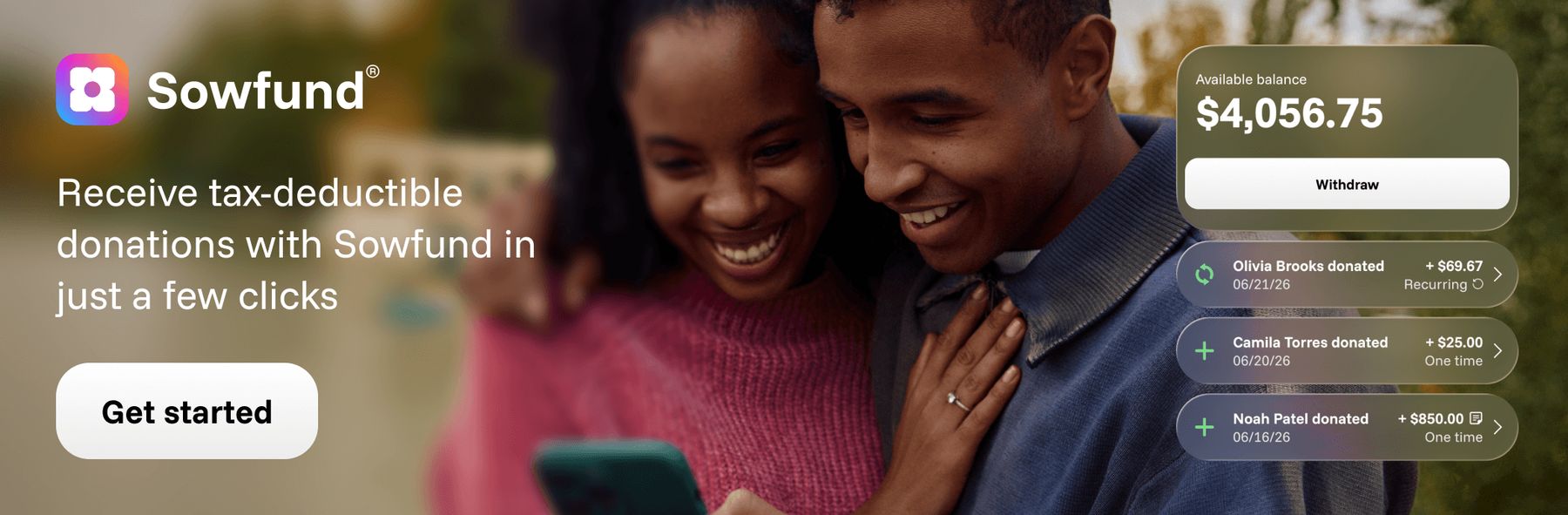
Sowfund takes a different starting point. It's a registered 501(c)(3) nonprofit that onboards individual Christian missionaries, so donations made through the platform are tax-deductible to the donor under Sowfund's own nonprofit status, not the missionary's.
Most missionaries, especially those just starting out or serving with a smaller sending organization, don't have their own 501(c)(3). Filing for one is a slow, expensive process, and plenty of faithful, active missionaries never end up needing to go through it for their own personal support-raising. Sowfund exists for exactly that gap: a missionary signs up, goes through a review, completes identity verification through Stripe, and gets a public profile page they can use to raise ongoing support, not just for a single trip, but for the long haul.
Sowfund is free for missionaries and donors to use. The platform runs on a 5% service fee per donation plus standard processing costs (2.2% + $0.30 for cards, 0.8% capped at $5 for ACH), and donors can choose to cover those fees at checkout, which about 85% of them do. There's no fee to withdraw funds, and every donor gets an automatic tax receipt plus an annual giving statement for their records.
The Real Difference: Who Each Platform Can Onboard
This is the part that actually determines which platform fits your situation, and it comes down to one question: does the person raising money already have their own registered nonprofit status?
If the answer is yes, and you're an established organization with 501(c)(3) status (or an equivalent in your country) that wants to fund specific, visible projects with video updates, DonorSee's model was built with you in mind.
If the answer is no, and you're an individual missionary, a smaller ministry, or someone serving under a sending organization that doesn't handle personal support-raising for you, Sowfund's model was built with you in mind. Because Sowfund itself holds the 501(c)(3) status, it can extend tax-deductible giving to missionaries who don't have that infrastructure, and even to missionaries serving outside the US, since Sowfund donors can give from anywhere in the world.
Giving Structure: Ongoing Support vs Project-Based Campaigns
The two platforms also structure the actual act of giving differently.
DonorSee is organized around individual, fundable projects. A partner posts a specific need, it gets funded, and donors receive video proof of the outcome. It's a strong model for one-off, tangible needs where a donor wants to see exactly what their gift accomplished.
Sowfund is organized around an ongoing relationship. A missionary's profile page (at their own short link, sow.fund/username) exists as a permanent home base for support-raising, not a campaign with a start and end date. Missionaries can also create individual fundraisers for specific trips or projects alongside their main profile, so both an ongoing support base and a project-specific campaign can run at the same time, linked together on the same account.
If you're trying to fund a single, defined project through an established charity, a project-based model makes sense. If you're trying to build and sustain a long-term donor base as an individual missionary, an ongoing profile makes more sense. It's worth thinking about which pattern actually matches how you raise support.
Which Platform Fits Your Situation
Here's a simple way to think about it, based on what each platform is actually built to do:
Choose DonorSee if you represent a registered nonprofit or charity, you have (or can meet) the financial and banking setup for an established organization, and you want a video-first way to fund specific, discrete projects with a built-in storytelling format.
Choose Sowfund if you're an individual missionary or a smaller ministry without your own 501(c)(3), you need an ongoing profile to raise long-term support rather than a single project, or you want your donors to have automatic, US-recognized tax deductibility without you needing to set up nonprofit status yourself.
Some missionaries may even find a use for both over time. A missionary serving under a larger organization that already runs its own DonorSee-style project campaigns might still want a personal Sowfund profile for their own ongoing, individual support base. The two aren't mutually exclusive; they just serve different layers of the same mission.
The Bottom Line
Sowfund and DonorSee aren't really competing for the same person. DonorSee is a strong, well-established option for registered charities that want to fund specific projects with video accountability. Sowfund exists to fill a different need: giving individual missionaries and smaller ministries, who don't have their own nonprofit status, a straightforward way to raise ongoing, tax-deductible support.
The right question isn't which platform is objectively better. It's which one matches your organization's status and how you actually raise support. Once you answer that, the choice tends to make itself.