Best Christian Fundraising Platforms Compared (2026)

Vlad Radchenko · Co-founder, Sowfund · 5 min read | May 8, 2026
If you're a missionary, ministry worker, or church leader looking to raise support online, you already know the landscape is crowded. There are dozens of fundraising platforms out there — but most of them were built for birthday parties and medical bills, not long-term mission work.
The difference matters more than most people realize. The platform you choose affects whether your donors get a tax deduction, how much of each gift actually reaches you, and whether the tool is built for the kind of ongoing, relationship-based support that missions require.
This guide breaks down the best Christian fundraising platforms available in 2026 — what each one does well, what it gets wrong, and who it's actually built for.
What to Look for in a Christian Fundraising Platform
Before diving into the comparisons, it helps to know what separates a great platform from a mediocre one for faith-based fundraising. Here are the four questions that matter most:
1. Are donations tax-deductible? This is huge. Donors who give through a registered 501(c)(3) can deduct their gifts on their US tax return. Platforms that aren't 501(c)(3) organizations — or that simply process payments without acting as fiscal sponsors — can't offer this. For many supporters, a tax deduction is the difference between giving $100 and giving $500.
2. Is it built for recurring support? Mission work is a long game. A platform designed around one-time campaigns is useful for a specific trip or project, but it won't serve the missionary who needs to build a stable, monthly donor base over years.
3. What does it actually cost? Platform fees, processing fees, and withdrawal fees add up. Some platforms advertise "free" but quietly charge donors or take a percentage of every gift. Know the full fee structure before you commit.
4. Does it understand ministry? A platform built for general crowdfunding won't have features missionaries actually need — things like a permanent profile for ongoing support, a custom shareable link, QR codes for church presentations, or in-app tools to encourage monthly giving.
With those filters in mind, here's how the leading platforms stack up.
Platform Comparison at a Glance
| Platform | Built for Missions? | Tax-Deductible? | Platform Fee | Recurring Giving? | Free for Missionaries? |
|---|---|---|---|---|---|
| Sowfund | ✅ Yes | ✅ Yes (501c3) | 5% | ✅ Yes | ✅ Yes |
| GiveSendGo | Partially | ❌ No | 0% (tips-based) | Limited | ✅ Yes |
| GoFundMe | ❌ No | ❌ No | 0% (processing only) | ❌ No | ✅ Yes |
| Donorbox | For nonprofits | Depends | 1.5% (up to $50k/mo) | ✅ Yes | ❌ No |
| Fundly | ❌ No | ❌ No | ~4.9% | Limited | ✅ Yes |
Sowfund
Best for: Individual missionaries needing ongoing support with tax-deductible giving
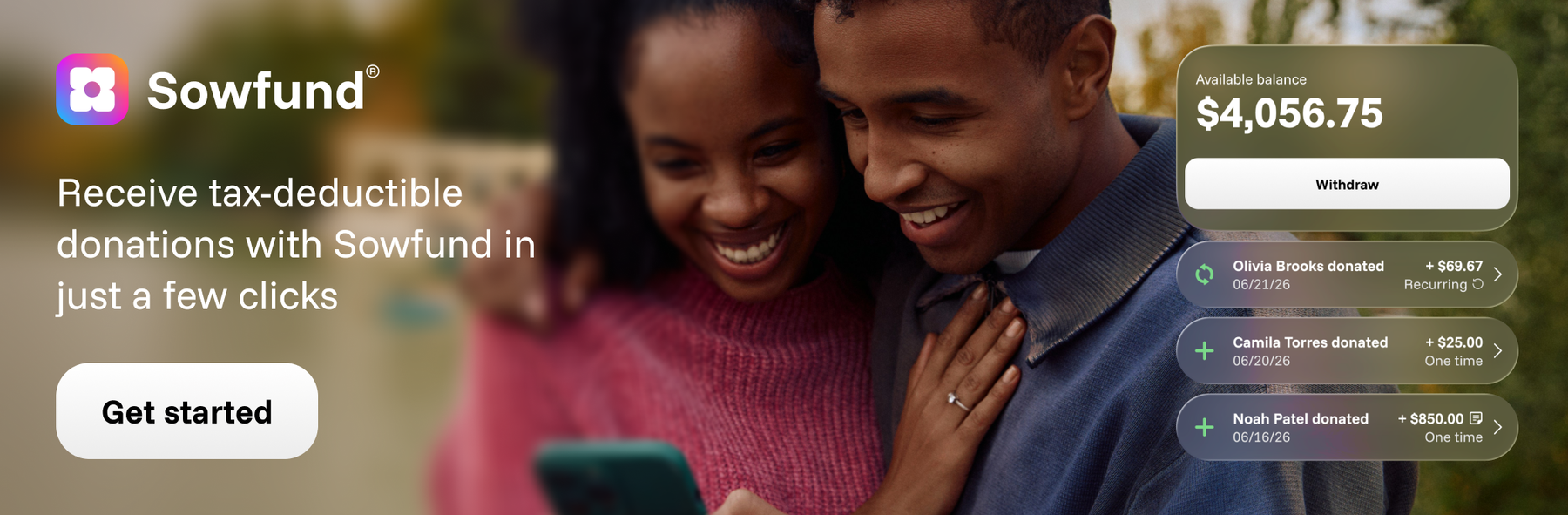
Sowfund is the only platform on this list that was built specifically for Christian missionaries — not as an afterthought, but as its core purpose. It operates as a registered 501(c)(3) nonprofit, which means every donation made through the platform is tax-deductible to the donor. That's not just a nice feature; it's a meaningful competitive advantage when you're asking people to become long-term monthly supporters.
Here's how it works: missionaries sign up, submit an application for review (approval typically takes within 72 hours), and once approved, they get a permanent public profile page with their own custom link — for example, sow.fund/yourname. That profile is their home base for all ongoing support-raising. They can also create separate fundraisers for specific trips or projects, which live on their profile and link back to it.
Fees: Sowfund charges a 5% service fee per donation, plus standard payment processing fees (2.2% + $0.30 for cards; 0.8% capped at $5 for ACH bank transfers). Crucially, approximately 85% of donors choose to cover all fees themselves during checkout — which means most missionaries receive gifts with little or no deduction. There are no withdrawal fees, and missionaries never pay anything out of pocket or enter card details.
What stands out:
- Tax-deductibility for US donors — even if the missionary serves overseas
- Monthly recurring giving built into every profile and fundraiser
- Custom short link (sow.fund/username) that's ready the moment you're approved
- QR codes on every profile and fundraiser page — ideal for church presentations and sharing amongst your group
- An optional feature that automatically suggests a smaller monthly gift to donors who try to give a larger one-time amount — one of the most underrated tools for building a recurring base
- Fully customizable profile with a photo, bio, ministry focus, serving location, personal story, social links, and more
- The ability to create dedicated fundraisers to collect donations for a specific mission trip, project, or purpose — separate from your ongoing profile giving
- Automatic donation receipts and year-end tax statements for every donor
- Free to use for missionaries, donors, and churches alike
The honest drawback: Sowfund launched relatively recently, which means it's still growing in scale and name recognition compared to more established platforms. It doesn't yet have the same breadth of social proof or community size as some older alternatives — though that gap is narrowing.
GiveSendGo
Best for: One-time campaign fundraising for any Christian cause
GiveSendGo is the most recognizable name in Christian crowdfunding, and for good reason — it's been around since 2008, has a strong faith-based brand identity, and charges 0% platform fees (the platform is sustained by optional donor tips).
It's a solid choice for time-limited campaigns: a mission trip, a medical crisis, a church building fund. The platform is simple to use, and the Christian positioning reassures both donors and fundraisers.
The key limitation: GiveSendGo is not a 501(c)(3) organization, which means donations made through the platform are generally not tax-deductible. For casual donors giving smaller amounts, this may not matter. But for supporters who want to give significantly — and claim it on their taxes — it's a real barrier. A long-term supporter giving $200 a month would be leaving a $2,400 annual deduction on the table.
GiveSendGo also lacks the missionary-specific infrastructure that platforms like Sowfund offer: there's no permanent profile built for ongoing support, no feature set designed around monthly giving relationships, and no 501(c)(3) fiscal sponsorship that makes missionaries' fundraising legitimate in the eyes of the IRS.
Best use case: One-time campaigns for short-term trips, crisis fundraising, or causes that don't require tax-deductibility.
GoFundMe
Best for: Raising money quickly from a wide general audience
GoFundMe is the largest crowdfunding platform in the world, and there's no question it has reach. For missionaries, the appeal is obvious: everyone has used GoFundMe, everyone trusts it, and the barrier to getting a page up is essentially zero.
But GoFundMe wasn't built for missionaries — and it shows. Donations are not tax-deductible. There's no recurring giving for ongoing monthly support. The platform has no understanding of what a missionary profile is, no features for in-person support-raising, and no faith-based community or framing. A missionary using GoFundMe for long-term support will constantly feel like they're using a tool built for someone else.
Fees: GoFundMe charges no platform fee, but the payment processing fee (typically 2.9% + $0.30 per transaction) still applies.
Best use case: Quick, one-time campaigns where reach matters more than tax-deductibility — emergency fundraising, disaster relief, short trips within an existing network. Not recommended for missionaries building long-term support.
For a direct feature comparison, see our full GoFundMe vs Sowfund breakdown.
Donorbox
Best for: Established nonprofits and churches with existing donor infrastructure
Donorbox is a powerful tool — but it's built for organizations, not individual missionaries. If your church wants a giving page on its website, or your nonprofit needs embedded donation forms with recurring billing, Donorbox is worth considering.
It does offer recurring donations, a relatively clean donor experience, and integrations with tools like Salesforce and Mailchimp. For an established ministry organization, it's a legitimate option.
Fees: 1.5% platform fee on donations up to $50,000/month; free for nonprofits processing under $1,000/month. Payment processing fees apply on top.
The limitation for missionaries: Donorbox doesn't offer fiscal sponsorship or 501(c)(3) status. If you're an individual missionary without your own nonprofit entity, the tax-deductibility question remains unanswered. The platform is also more complex to set up than tools designed for individuals.
Best use case: Church giving pages, established ministry organizations with their own 501(c)(3), nonprofits that need embedded giving forms on their website.
Fundly
Best for: Simple, one-time personal or school fundraising campaigns
Fundly is a general personal fundraising platform often used by Christian schools and churches for event-based campaigns. It's straightforward, supports social sharing, and has a reasonable track record for short campaigns.
Fees: ~4.9% platform fee, plus payment processing on top — making it one of the more expensive options on this list for higher-volume fundraising.
The limitation for missionaries: Donations are not tax-deductible, there's no recurring giving designed for long-term support, and the platform has no faith-specific features. At 4.9%, the fee structure also eats into gifts more than most alternatives.
Best use case: School fundraisers, one-time church events, small campaigns where simplicity matters more than cost or tax-deductibility.
Which Platform Is Right for You?
If you're a missionary raising long-term monthly support: Sowfund is the clear choice. It's the only platform purpose-built for missionaries, offers tax-deductible giving through its 501(c)(3) status, and has the recurring giving tools and profile infrastructure for ongoing support relationships.
If you need a one-time campaign for a short-term trip: GiveSendGo or GoFundMe will both work. GiveSendGo's Christian community and branding give it an edge if your donors are faith-motivated. GoFundMe has broader reach.
If you're a church or established nonprofit: Donorbox deserves a look, especially if you want embedded giving forms and CRM integrations.
If you're a missionary who also wants fundraisers for specific trips: Sowfund handles both — your permanent profile for ongoing support and separate fundraisers for specific projects, with all funds trackable from one wallet.
Frequently Asked Questions
Are donations to missionaries tax-deductible? They can be — but only if the platform facilitates giving through a registered 501(c)(3) nonprofit. Sowfund is structured as a 501(c)(3) and holds funds on behalf of each missionary, making every donation tax-deductible for US-based donors. Platforms like GoFundMe and GiveSendGo do not offer this.
Do missionary fundraising platforms charge fees? Every platform has some form of cost, whether it's a platform fee, processing fees, or both. Sowfund charges a 5% service fee plus payment processing, but about 85% of donors choose to cover fees themselves. The missionary never pays out of pocket.
Can I raise missionary support if I serve overseas? Yes. Sowfund is available to missionaries from multiple countries (see sowfund.org/supported-countries), and US-based donors can give from anywhere in the world while receiving a tax deduction — even if the missionary is serving internationally.
What's the fastest way to get a missionary fundraising page live? Sowfund typically approves applications within 72 hours. Once approved, your profile page and custom link are live automatically — no extra setup required.
The Bottom Line
There's no shortage of platforms willing to process your donations — but most of them weren't thinking about missionaries when they built their product. If you're raising long-term ministry support, the platform you choose should be able to give donors a tax deduction, support recurring monthly giving, and actually understand what missionary support-raising looks like in practice.
That's why Sowfund exists. It was built for this exact purpose — and it's free to get started.